
See the why behind every agent action.
WhyOps makes agent decisions legible, replayable, and fixable. Stop guessing, start shipping reliable autonomy. Built for teams moving from agent demos to production systems.
of organizations used AI in 2024
Stanford HAI says mainstream AI adoption is already here, which raises the cost of blind spots in production.
Stanford HAI, AI Index 2025of knowledge workers already use AI at work
Microsoft found generative AI use has moved from experimentation into day-to-day work.
Microsoft Work Trend Index, 2024of AI users bring their own AI tools to work
Tool sprawl makes governance and debugging harder before teams even standardize their stack.
Microsoft Work Trend Index, 2024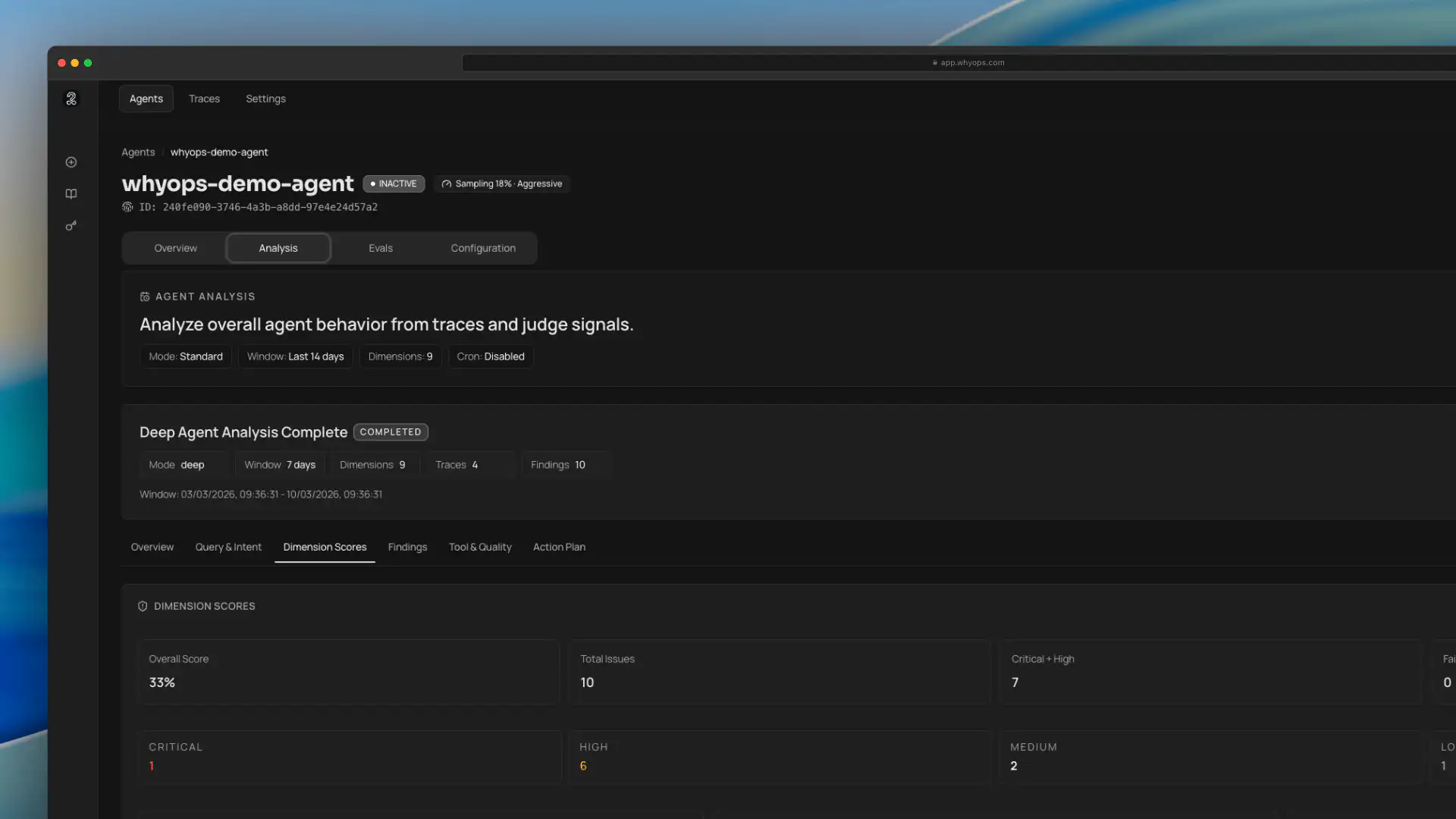
Fits your stack
Any model provider
Any tool or API
whyops_weather_agent.ts
Wrap your tools, route your LLM calls
WhyOps integrates with your existing agent framework. Wrap tools to track execution, route LLM traffic through our proxy to capture decision context.
pnpm add @whyops/ts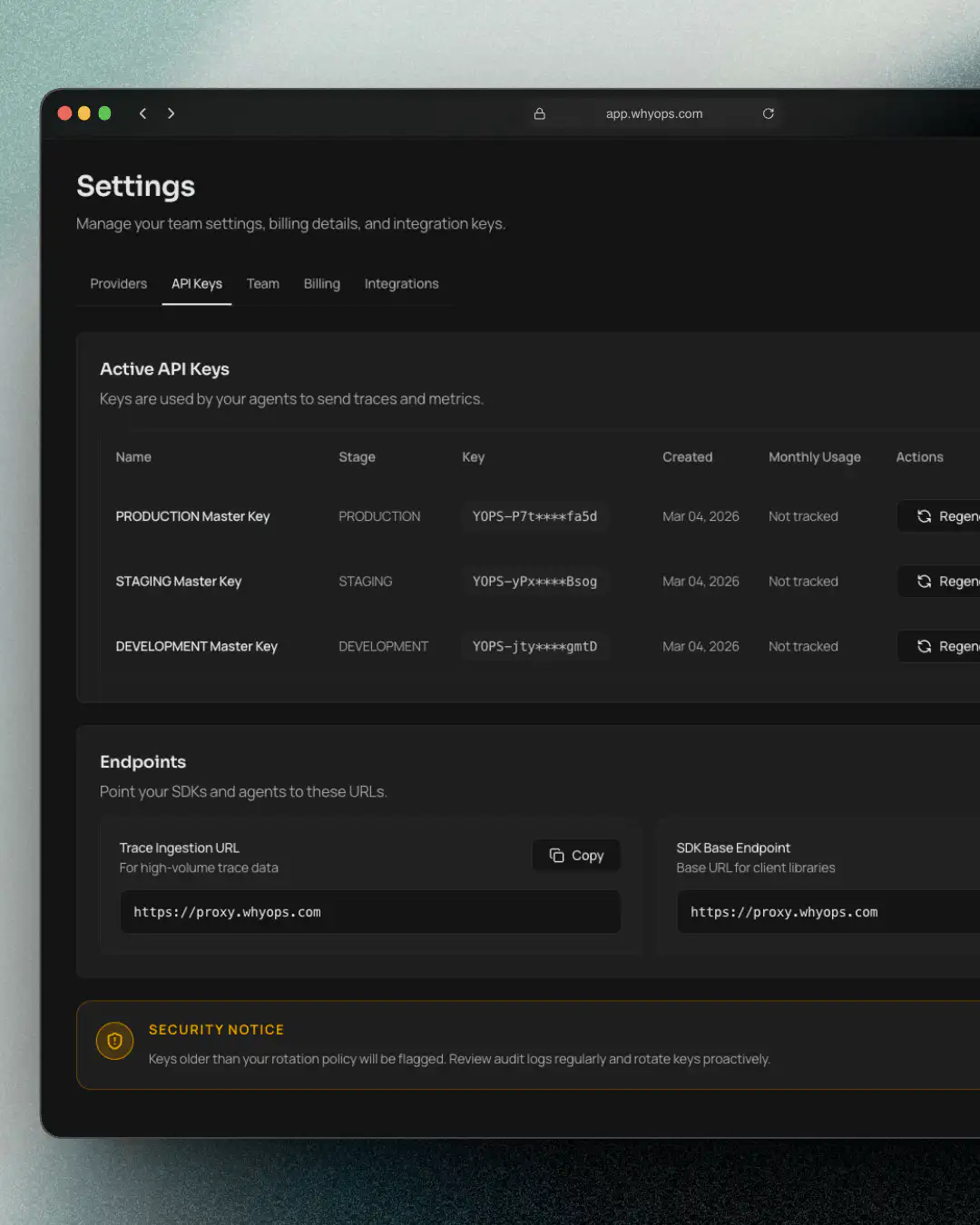
The Core Challenge
AI agents fail in production for reasons you cannot see. Teams can trace outputs, but they still struggle to explain why an agent chose a tool, skipped a guardrail, or drifted off course. Microsoft reports that 78% of AI users are already bringing their own AI tools to work, while Grafana says 70% of organizations now manage four or more observability tools. That combination makes agent failures especially hard to explain. Microsoft Work Trend Index, 2024 Grafana Observability Survey 2024
Why teams get stuck
Context drift
Agents lose the thread mid-run. Prompts look fine, but decisions quietly change.
Unreproducible failures
"Works on my machine" doesn't apply. Real data and timing make failures hard to reproduce.
Decision opacity
You can see outputs, but not why the agent chose a tool, ignored an instruction, or stopped early.
What the market data says
The visibility gap is measurable now. AI use is accelerating, observability stacks are fragmenting, and teams need a clearer way to inspect agent decisions before failures turn into incidents.
use generative AI in at least one business function
The problem is not AI adoption. It is making autonomous behavior inspectable once usage reaches production workflows.
Stanford HAI, AI Index 2025of organizations rely on four or more observability tools
Fragmented telemetry stacks already slow root-cause analysis before agent reasoning enters the picture.
Grafana Observability Survey 2024say centralized observability saved time or money
Teams already see economic value in unified visibility. Agent debugging needs the same consolidation for decision context.
Grafana Observability Survey 2024Benchmarks teams can actually cite
WhyOps is built for a market where AI adoption is ahead of governance, and where observability is still fragmented. The numbers below explain why agent debugging now needs decision context, not just traces.
use generative AI in at least one business function
The problem is not AI adoption. It is making autonomous behavior inspectable once usage reaches production workflows.
Stanford HAI, AI Index 2025of organizations rely on four or more observability tools
Fragmented telemetry stacks already slow root-cause analysis before agent reasoning enters the picture.
Grafana Observability Survey 2024say centralized observability saved time or money
Teams already see economic value in unified visibility. Agent debugging needs the same consolidation for decision context.
Grafana Observability Survey 2024"Observability is the ability to understand the internal state or condition of a complex system based solely on knowledge of its external outputs."
"Organizations that apply AI to drive growth, manage costs, and deliver greater value to their customers will pull ahead."
Where WhyOps fits
LangSmith
Great traces, limited agent reasoning.
Langfuse
Solid monitoring, shallow decision context.
Helicone
Strong metrics, limited debugging depth.
AgentOps
Basic monitoring, no replayable state.
The missing link: decision context
Others show what happened. WhyOps shows why it happened.
| Capability | LangSmith | Langfuse | WhyOps |
|---|---|---|---|
| Decision context (why) | Clear decision paths | ||
| State tracking | Full run history | ||
| Production replay | One-click reproduction | ||
| Context drift | Visible in the UI | ||
| Multi-agent graph | Causality chains |
The debugging copilot for agents
Replay any run, inspect the decision trail, and share the exact state with your team so fixes start from evidence, not guesswork. In IBM's definition, observability means understanding a system's internal state from its outputs. WhyOps extends that idea to agent runs by exposing the state, instructions, and decisions behind every action. IBM, What Is Observability?
Decision-aware state
Capture the state right before each decision so you can see what the agent saw.
Decision reasoning
Understand why a tool was chosen, why a step was skipped, and where the run veered off.
Production replay
Recreate production failures in dev with the exact context that caused the issue.
Multi-agent graph
See handoffs, dependencies, and where failures cascade across agents.
From failure to fix, fast
1. An agent fails in production
2. WhyOps reveals the missing decision context
Suggestion: tighten the instruction that was skipped.
3. Fix applied → replay verified → shipped
Visual Decision Debugger
Inspect every decision as clearly as a code trace.
Interactive state diff
Compare state before/after any decision and pinpoint the change that mattered.
Constraint tracker
Track instructions and see the exact step where they were dropped.
Guided fixes
Turn failure patterns into clear, actionable fixes your team can apply.
Frequently asked questions
Clear answers for teams evaluating decision-aware observability, replay, and production debugging for AI agents.
Why is agent debugging harder than normal application debugging?
Agent failures are driven by prompts, tool choices, hidden state, and changing context. Microsoft found that 78% of AI users are already bringing their own AI tools to work, while Grafana reports that 70% of organizations manage four or more observability tools. That combination makes root-cause analysis fragmented before teams even inspect agent reasoning.
What does decision-aware observability actually mean?
It means capturing the state, instructions, and outputs around each decision so teams can explain why an agent acted the way it did. IBM defines observability as understanding the internal state of a complex system from its external outputs. WhyOps applies that principle directly to agent behavior.
Why does replay matter for production AI systems?
Replay turns one-off incidents into repeatable debugging sessions. Stanford HAI reports that 71% of organizations already use generative AI in at least one business function, so teams need a way to reproduce failures with the exact context that caused them instead of guessing from logs alone.
Why is centralized visibility important before scaling agents?
Because fragmented telemetry slows trust and incident response. Grafana found that 79% of organizations said centralized observability saved time or money. The same principle applies to agent systems: teams need one place to inspect decisions, replay runs, and share evidence during fixes.

Ready to ship with confidence?
Join teams making agent decisions legible, replayable, and fixable.