
Why DESIGN.md Broke the Internet in Under 24 Hours
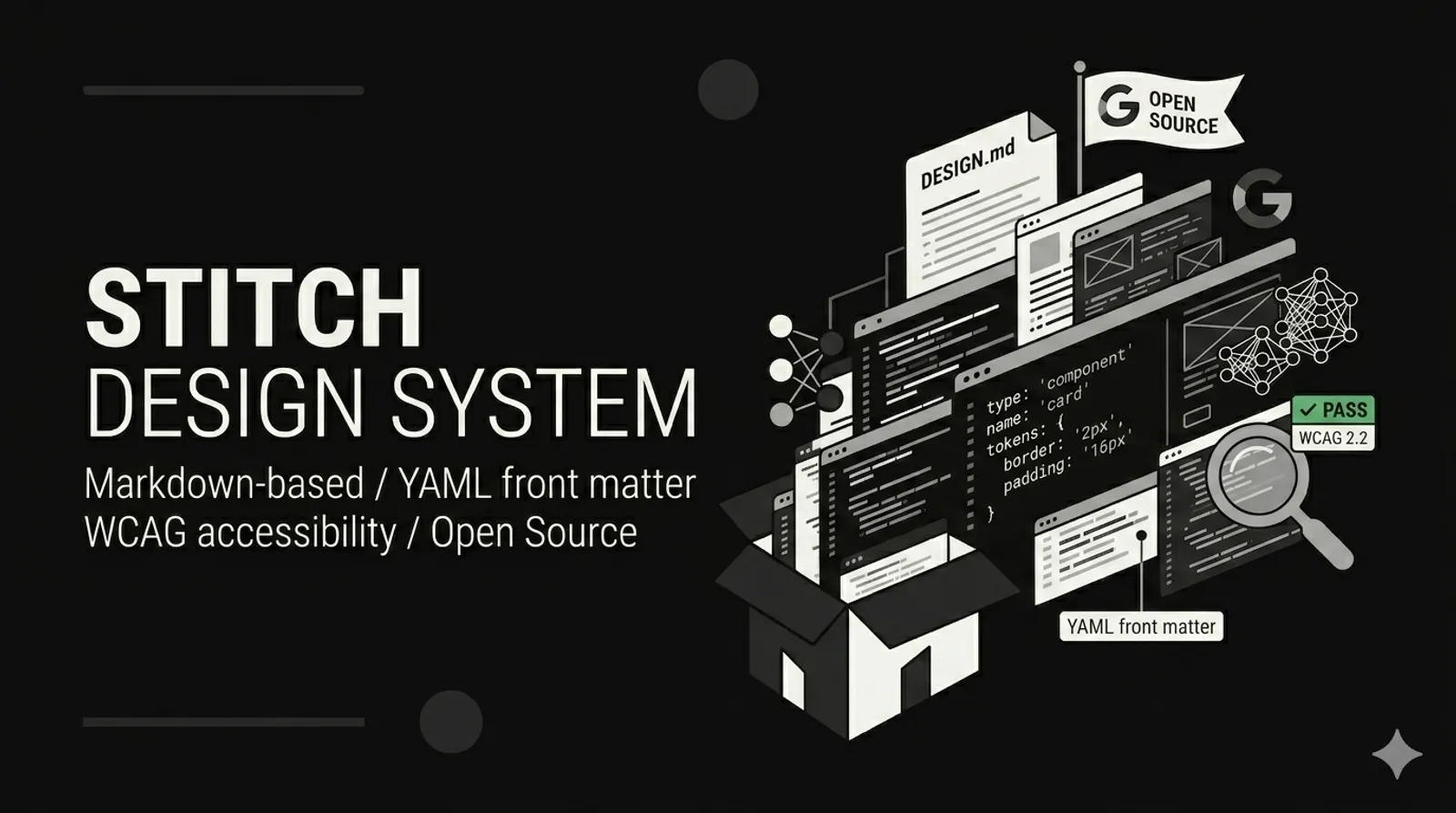
2.2 million views. 10,000 likes. 14,000 bookmarks. A single tweet from Google's Stitch team dropped the open-source spec for DESIGN.md and the internet lost it. Someone replied "if Figma was on life support, someone just pulled the plug." Another person straight up thought it was a parody account mocking Claude's design tool. That is how fast things move now.
And here's the thing. By the time you read this, three more people will have built something on top of it.
What actually is DESIGN.md
Here is the simplest way to think about it. You know how every coding agent right now generates UI that looks like it was made by someone who has never seen a color wheel? DESIGN.md fixes that by giving the agent a file that says exactly what your design system looks like.
The file has two layers. YAML front matter at the top with machine-readable tokens. Colors, spacing, typography, border radius. Then markdown prose below that explains why those values exist and how to use them.
---
name: Heritage
colors:
  primary: "#1A1C1E"
  tertiary: "#B8422E"
typography:
  body-md:
    fontFamily: Public Sans
    fontSize: 1rem
---
An agent reads this and knows your buttons use Boston Clay, your body text is Public Sans at 1rem, and your background is warm limestone. Not because it guessed. Because you told it.
The spec supports component definitions too. You can map a button-primary with backgroundColor, textColor, rounded corners, and padding. Hover states get their own entry. The agent knows exactly what a button looks like in your system, not some generic rounded rectangle it made up.
The CLI ships with a linter. Run npx @google/design.md lint DESIGN.md and it checks your tokens for broken references and WCAG contrast ratios. It spits out structured JSON. Agents can act on that directly.
There is also a diff command. Compare two versions of your design system and detect regressions. Token-level, prose-level, the whole thing.
How it works in practice
Most tutorials tell you to describe your design in a prompt. "Make it modern. Use blue. Clean typography." And then you get back something that looks like a 2018 SaaS landing page. Every single time.
What actually happens with DESIGN.md is different. You drop the file in your project root. Your agent reads it on startup. And then every UI it generates conforms to your system automatically.
The GitHub repo includes a full example called "Heritage." Architectural minimalism meets journalistic gravitas. Deep ink headlines, warm limestone background, Boston Clay for interactions. Reading the file, you can picture the product before a single line of code is written. That is the point.
Here is what the sections look like in order:
- Overview - brand and style direction
- Colors - palette with hex values and context
- Typography - font families, sizes, weights
- Layout - spacing and grid rules
- Elevation - shadows and depth
- Shapes - border radius and form
- Components - reusable UI patterns
- Do's and Don'ts - usage guidelines
You do not need all of them. But if you include a section, it has to follow this order. That is the spec.
Why people lost their minds
i used to think design systems were for big companies with dedicated design teams. Figma files, Storybook setups, token pipelines. The works. But that was before every solo developer started building with AI coding agents.
Now the bottleneck is not writing code. It is getting the code to look like it belongs to the same product.
"Plain text spec files are becoming the universal agent config layer. CLAUDE.md for behavior, DESIGN.md for visuals, AGENTS.md for coordination."
That is Chen Avnery on X. He runs 12 agents off structured markdown files. He is not alone in this thinking.
Dev Anon put it differently. "Moving design from art to infrastructure. Agents need structured intent, not guesswork. WCAG validation as code is long overdue."
The funniest reaction to the announcement was from Gautham Pai. He saw the GitHub repo was called design.md and genuinely thought Google was somehow executing markdown files. "Markdown really is code now? What kind of sorcery is that." He realized it was just the repo name. The screenshot of his confusion got hundreds of views.
Paul Never had a similar moment. "At first I thought its a parody account mocking Claude design." Which, to be fair, is not an unreasonable reaction in 2026 when every other startup names itself after a file extension.
Meanwhile, someone was already launching designdotmd.directory within 24 hours. A collection of hundreds of DESIGN.md files ripped from real websites. Another person built design-extractor.com to auto-generate these files from any URL. And Ozmen had been building custom specs on top of Stitch's first release for weeks. He posted an update saying he would revise everything to match the new open spec.
The speed of ecosystem building around this is absurd. Luong Nguyen commented that he had already built a similar approach called sleek-ui two weeks before the announcement. His GitHub repo was right there in the replies. Same idea, different execution.
Amaan Khan said he one-shotted his entire Claude character animation site using Claude directly. Then added "waiting for the day stitch is that capable." The bar is already high and people want Google to match it.
The honest take
Not everyone is convinced. Sergi Campmany asked a fair question: "How is that different from telling your coding agent to create a globals.css and a .md file referencing each token? Why is a standard needed for this?"
He has a point. You could approximate this with a prompt and a CSS file. The standard matters for interoperability. If Claude, Cursor, Windsurf, Copilot, and every other agent can read the same DESIGN.md format, you stop rewriting your design rules for every tool.
But right now the spec is still in alpha. Someone reported constant timeouts when connecting Stitch through MCP. "Great designs but unusable unless you solve that." Another person just said "I wish Stitch was intuitive." And ThisAndThat asked the most basic question of all: "But I have no design rules. So how can I export them?"
If you do not have a design system, DESIGN.md will not magic one into existence. You still need to make design decisions. The file just gives you a place to write them down in a way agents can read.
The idea is solid. The execution is early.
The bigger picture
What Google is doing here is not really about a file format. It is about claiming the default for how AI agents understand visual design. The company that defines that standard wins massive developer mindshare.
Claude has its own design rules. Vercel has design tokens. But neither open-sourced a spec that any tool can use. Google did.
And the community response tells you everything. Within a day, people are building directories, extractors, and alternative implementations. Someone asked for the same thing for finance and ML. Another person said "every system, even design system, is just an md file."
Look. Markdown is eating the world. First it was READMEs. Then CLAUDE.md for agent behavior. Now DESIGN.md for visual identity. The pattern is clear. The simplest possible format wins because every agent can read it.
Whether Google's spec becomes the actual standard or someone else forks it into something better, this is the direction. Design systems are becoming text files. And honestly, that makes sense. Text files are the one thing every tool agrees on.